To him who loves us and has freed us from our sins by his blood and made us a kingdom, priests to his God and Father, to him be glory and dominion forever and ever. Amen. (Revelation 1:5b-6 ESV)
At the heart of Revelation is the gospel of Jesus Christ. This isn’t a surprising feature of the book, but makes it worth taking a deeper look into John’s doxology above. In the ancient world the Greek word for gospel (euangelion), also translated as good news or glad tidings, held political significance, referring to history-making, world-shaping reports of political, military, or societal victories.
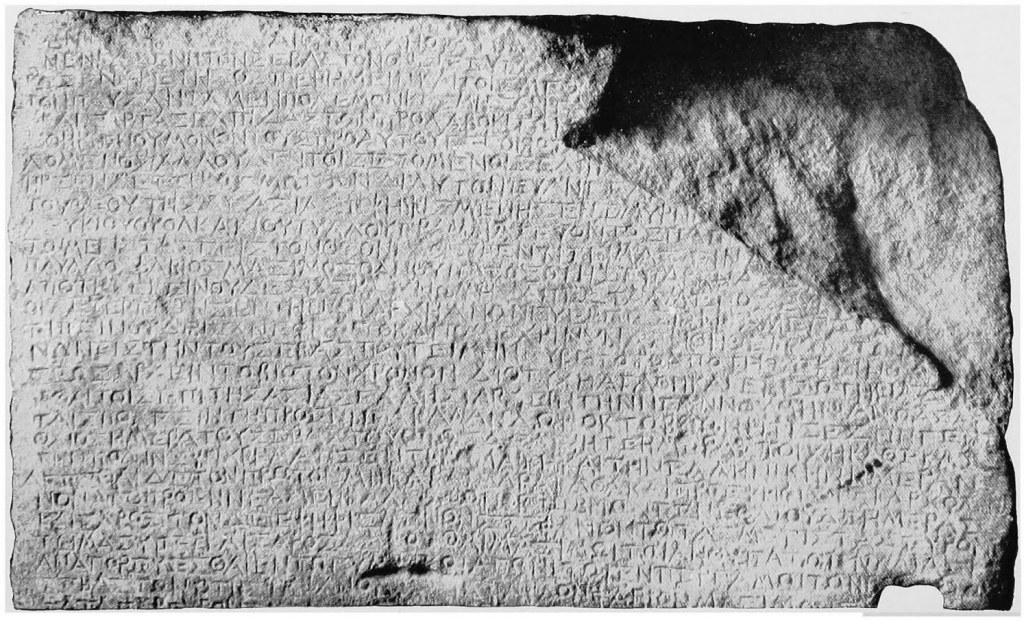
One such pronouncement has been preserved in a Greek inscription (pictured above) dated from 9 B.C. and uncovered in Priene, a small Greek city on the coast of the Aegean Sea not far from the city of Miletus in the Roman province of Asia.
Since Providence, who orders all our lives has in her display of concern and generosity in our behalf adorned our lives with the highest good by giving us Augustus, whom she filled with virtue for the benefit of humanity, sending him as a savior, both for us and for our descendants, that he might end war and put everything in peaceful order, and since he, Caesar, by his appearance (exceeding even our expectations),not only by surpassing the benefits conferred by his predecessors but by leaving no expectation of surpassing him to those who would come after him, and since the birthday of our god Augustus was the beginning of the good news for the world that came because of him.
This proclamation attributing Caesar Augustus with divinity declared him to be virtuous to the benefit of all mankind. He was sent as a savior, who was credited with bringing peace to the world. His greatness no one could surpass whether then or in the future. His birth was the source of good news for the world. In short his advent changed everything.
Within a few years a Jewish peasant named Jesus made competing claims of divinity, virtue, salvation and peace. Christians claimed that his advent was history-making and world-shaping. He was a divine savior who would end war surpassing all previous benefactors. If the glad tidings about Jesus were true, he would expose Caesar as a fraud, a mere parody of the genuine savior, Jesus Christ. We begin to see why Rome saw this messiah’s church as a threat targeting it for persecution.
John’s doxology begins with the good news of Jesus’ love for us. That love moved him to free us from the slavery of sin by his blood. That love moved Jesus to make us into a people of his own, a kingdom in which we serve not as lowly slaves, but as noble priests. Because his dominion is eternal and universal, Jesus will establish a true and lasting peace over all creation. This good news is the real thing, not the parody of good news attributed to Augustus.
Politicians today continue to make claims like the ones the Caesars made. We have heard them promise that their election will save the country. They take credit for any prosperity that we enjoy as if they created it. They promise to protect us, yet often fail to do so. They legislate health care systems, but cannot heal. They arrogantly assert that war will bring peace. We must not buy their claims or fall for their promises. We must never place our hope in men who will inevitably fail us, but trust in Jesus Christ who loves us, whose promises are sure and whose dominion is eternal. His advent truly was the beginning of good news for the world.
To him who loves us and has freed us from our sins by his blood and made us a kingdom, priests to his God and Father, to him be glory and dominion forever and ever. Amen.
 A Revelation Invitation
Leave a comment