And a great sign appeared in heaven: a woman clothed with the sun, with the moon under her feet, and on her head a crown of twelve stars. She was pregnant and was crying out in birth pains and the agony of giving birth. And another sign appeared in heaven: behold, a great red dragon, with seven heads and ten horns, and on his heads seven diadems. His tail swept down a third of the stars of heaven and cast them to the earth. And the dragon stood before the woman who was about to give birth, so that when she bore her child he might devour it. She gave birth to a male child, one who is to rule all the nations with a rod of iron, but her child was caught up to God and to his throne. (Revelation 12:1-5 ESV)
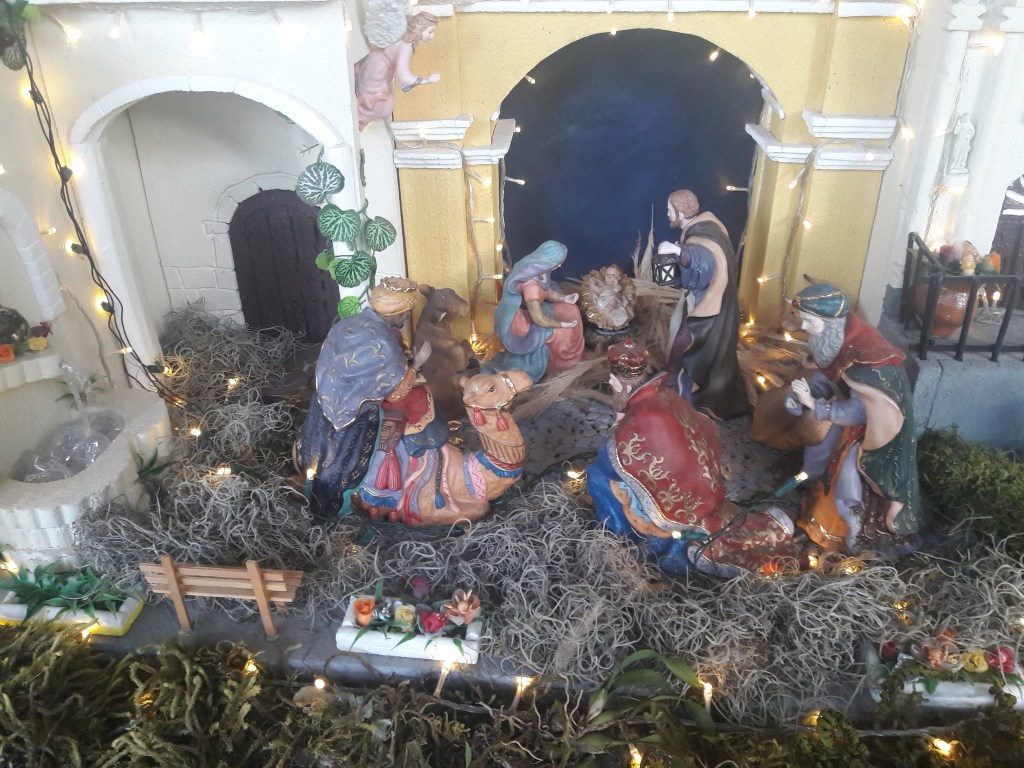
A common Christmas sight whether on your church’s lawn, in your neighbor’s yard or on your fireplace mantel is the traditional nativity scene: Wise men bearing gifts; shepherds gazing in wonder; angels in the rafters praising God; a cow, a sheep or two and a donkey grazing on hay. At the center are Mary and Joseph adoring their swaddled, infant son lying in a wooden, hay-filled manger. While these displays may vary in detail, without exception they lack one feature—a fierce, menacing, hideous red dragon with seven heads and ten horns and seven crowns on its heads hovering over the stable with teeth bared and claws out eager to snatch the baby boy from his mother’s grasp to devour him. Without the dragon the nativity scene is incomplete.
The dragon’s presence highlights how vulnerable our God made himself by becoming an infant, the most helpless of creatures. The Son of God, our Savior, clothed himself in human frailty. We recall how that dragon incited a ruthless King Herod to slaughter the young boys of Bethlehem hoping to devour Jesus in the sweep. Herod and the dragon conspired to prevent the coronation of this King of the Jews. Throughout Jesus’ life the dragon endeavored to thwart God’s plan to redeem his creation incessantly harassing and tempting the vulnerable male child. At the cross where Jesus suffered alone, the dragon thought he had finally foiled God’s plan only to be humiliated in utter defeat when Jesus rose from the dead being “snatched up to God and to his throne.” When he was at his most vulnerable, Jesus literally saved the world.
This horrifying scene illustrates the paradoxical nature of God’s power. As a man Jesus shared in our human weakness while powerfully fulfilling his mission. And God continues to work powerfully through weakness. Neither old age, physical handicap, immigration status, unemployment, addiction, nor any other circumstance hinders God’s working forcefully and effectively in people’s lives today. My father lived to be 81 years old. At his funeral I learned that one woman in his church was shocked at his passing because my elderly dad, as was his practice, had called two days earlier to encourage her in her illness. A wheelchair-bound friend writes puppet show scripts for her church’s children’s ministry. An immigrant friend raises money to educate children who live in poverty in his country of origin. An unemployed friend serves meals every week to the poor. A friend who is an addict effectively counsels others to overcome their addictions through the love and power of Jesus Christ. Our weaknesses and vulnerabilities not only serve as a reminder of God’s power, but are no hindrance to God’s power.
Even our sin does not hinder the work of Jesus Christ. Rather, the joy we express in our salvation is a testimony to others of rescue that can be theirs through Jesus Christ. That’s the message of the gospel—“My grace is sufficient for you, for my power is made perfect in weakness.” (2 Corinthians 12:9 ESV) Christmas is a wondrous reminder of the paradox of divine power: Our almighty God became weak and vulnerable so that the weak and vulnerable might embody his great power.
Merry Christmas
 A Revelation Invitation
Leave a comment