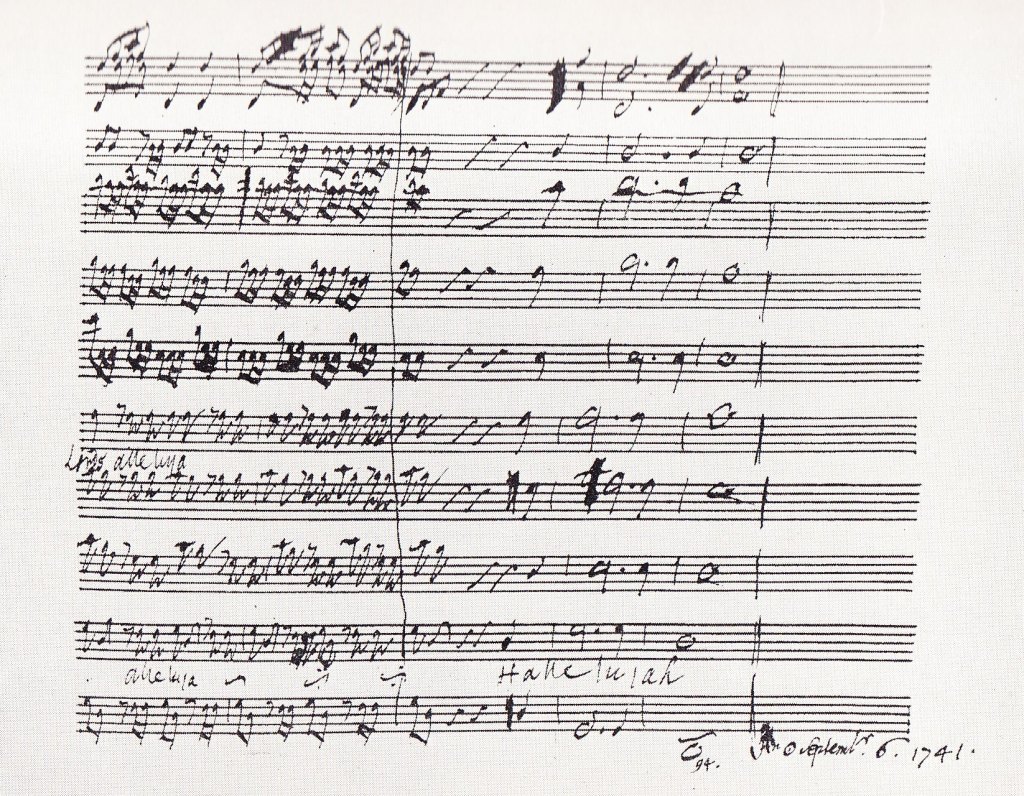
(The final bars of the Hallelujah chorus, from Handel’s manuscript)
Hallelujah: for the Lord God omnipotent reigneth. … The kingdoms of this world are become the kingdoms of our Lord, and of his Christ; and he shall reign for ever and ever. … King Of Kings, And Lord Of Lords. (Revelation 19:6b; 11:15b; 19:16b – King James Version)
Sound familiar, but in another setting perhaps? This is the text adopted by George Frideric Handel when composing the Hallelujah chorus as part of his oratorio masterpiece Messiah. Some music scholars assert that its first few notes are the most recognizable in the world.
Handel was a German-born English composer of the eighteenth century who enjoyed much success. However, as musical tastes in England changed, his style (particularly opera) fell out of favor. It was at a time in his life when Handel was in debt and deeply depressed that he was approached by a group of charities from Dublin, Ireland to compose a new work for a benefit performance that would help free men from debtors’ prison. For the text of this new work, he used a script, a libretto, he had received from his friend Charles Jennens taken directly from the Bible. Handel sequestered himself in his home where he created his hand-written, 260-page oratorio in just 24 days completing it on September 14, 1741. While composing Messiah, Handel was so engrossed in his task that he slept little and skipped meals. On one notable occasion, his assistant went to Handel’s work area where he saw tears streaming down his face. When his assistant asked why he was crying, Handel held up the score of the Hallelujah chorus and proclaimed, “I did think I did see all Heaven before me, and the great God Himself seated on His throne, with His company of Angels.” Little wonder this glorious song continues to inspire nearly three centuries after it was written as it lauds the supremacy of Jesus Christ.
The first performance of Messiah on April 13, 1742 was a great success raising 400 pounds which freed 142 men from debtors’ prison, a fate Handel himself narrowly escaped on several occasions. In the years that followed, performances of Messiah became an Easter tradition to raise money for the Foundling Hospital as well as for other charities benefiting the poor, the needy, the orphaned, the widowed and the sick.
Anyone who has ever taken in a live performance of the Hallelujah chorus has surely been moved by its beauty and majesty. We rise to our feet as we hear orchestral strings introduce the familiar opening melody. Complementing the rich orchestration are the four voices of the chorus in a choreographed dance—the heavenly strains of the sopranos, the crisp harmony of alto voices, the ringing tones of the tenors and the undergirding vigor of bass voices—each in its own, distinctive way proclaiming one unified message of the glory of the Lord God and the supremacy of his Messiah’s reign.
Unfortunately many, who lose themselves in the music and the moment, may miss the message of its Revelation text. Each of the four voices of the chorus highlights one aspect or another of the choral theme in its own particular way—sometimes going off on its own, at other times in harmony with its fellow travelers on their eschatological journey. But Handel, the master that he was, weaved those voices together into a single expression of praise and expectation. If we close our eyes and listen we may indeed see with our mind’s eye what John witnessed in his vision that day on the island of Patmos. Our faith will be strengthened in the eternal reign of the Almighty God. Our confidence will be renewed in the victory of our Lord Jesus over the powers and principalities of this dark world. We will see our Savior as the one who alone is King of kings and Lord of lords.
Great God of heaven, we lift our hands before you in praise of your power and might. You alone rule over all the earth. No throne is as great as your throne. All the rulers of this world will bow before you and acknowledge your sovereignty. We celebrate your Messiah, our Lord and Savior, who reigns over all creation as he leads us to victory over sin and death. May we shout in praise of you who alone are worthy. Amen.
 A Revelation Invitation
Leave a comment