I looked, and behold, a white cloud, and seated on the cloud one like a son of man, with a golden crown on his head, and a sharp sickle in his hand. And another angel came out of the temple, calling with a loud voice to him who sat on the cloud, “Put in your sickle, and reap, for the hour to reap has come, for the harvest of the earth is fully ripe.” So he who sat on the cloud swung his sickle across the earth, and the earth was reaped.
Then another angel came out of the temple in heaven, and he too had a sharp sickle. And another angel came out from the altar, the angel who has authority over the fire, and he called with a loud voice to the one who had the sharp sickle, “Put in your sickle and gather the clusters from the vine of the earth, for its grapes are ripe.” So the angel swung his sickle across the earth and gathered the grape harvest of the earth and threw it into the great winepress of the wrath of God. And the winepress was trodden outside the city, and blood flowed from the winepress, as high as a horse’s bridle, for 1,600 stadia. (Revelation 14:14-20 ESV)
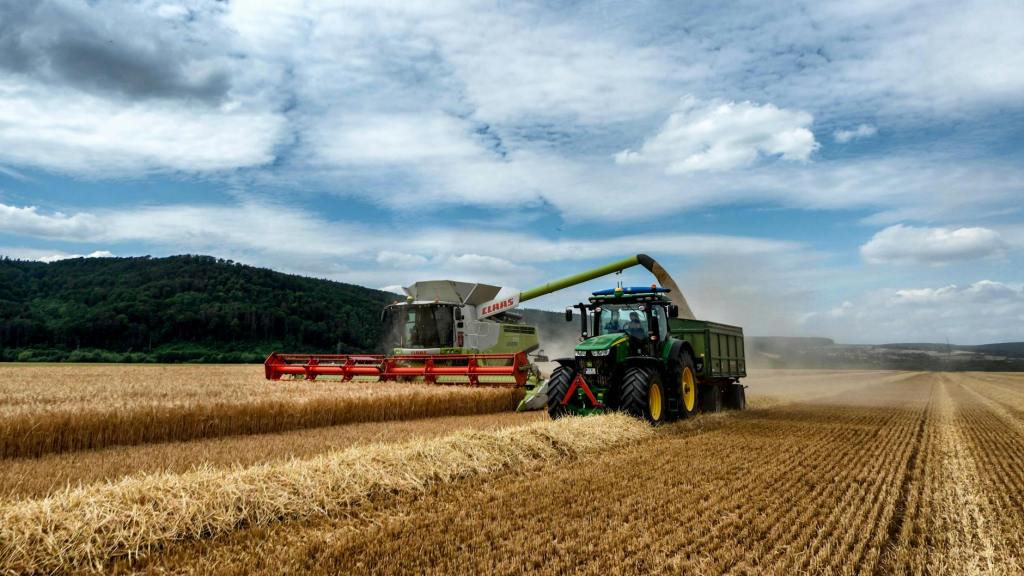
On a trip to Oklahoma I asked an old farmer what crops he grew (mostly wheat and corn). During our conversation I brought up what a marvel the harvest combine is. This machine is called a combine because it combines the steps of cutting, threshing and winnowing all in one process. Before the harvester has left his field, the stalks have been cut and discarded, the chaff separated and the ripened grain gathered for storage or sale. Harvest is a time of reckoning where the useful is separated from the useless. It’s no wonder prophets and teachers in the Bible portray God as a harvester.
In the passage above John showed his readers that a day of reckoning was upon them and the Roman Empire. The present tribulation would soon end. Those with faith in the son of man would be separated from Roman society as wheat is separated from chaff. They would be gathered as a harvester stores his grain. This didn’t mean that they wouldn’t suffer, but they would be separated, gathered and stored for the age to come.
That day of reckoning was also portrayed as a harvest of a different sort—that of grapes. This harvest is violent and destructive. When grapes are gathered they are thrown into a winepress where they are trampled, crushed and smashed to extract the juice. This harvest expresses the wrath of God. This winepress is located outside the city, that is, outside the church. When Jesus was crucified, he hung on a cross outside the city of Jerusalem. When he was killed, he bore the sins of the world upon himself so that we wouldn’t have to face God’s wrath. Those who reject his sacrifice will face God’s judgment having no one to intercede for them. In the context of Revelation, this points to the collapse and destruction of the Empire. Ultimately, anyone who is outside the city, outside spiritual Jerusalem, outside the church, will bear the full measure of God’s wrath on the day of judgment.
The harvest symbolizes both good news and bad news. For God’s people it is good news because we, his people, are valued; we are gathered; we are safeguarded. For God and his people judgment is a time of rectifying wrong whether in our present circumstances or at the last day. On the other hand the world, those who ignore God or defy him, will face bad news experiencing God’s wrath as he rights those wrongs. Those who place their faith in Jesus Christ and his sacrificial death escape that judgment. We can endure our light and momentary troubles knowing that the harvest is coming when God will gather us in.
God of the harvest, gather me in with your people. Rescue me from my enemies, from those who resist and provoke you, from those who mistreat your people. You are a God who demands a reckoning. You will right all wrongs that have been committed against you and your people. At the same time you are a loving and merciful God. I was subject to your wrath as well until Jesus interceded for me. I am grateful for the cross through which I escape your judgment. Amen.
 A Revelation Invitation
Leave a comment